
Stellar Spins deposit methods across cards, vouchers and crypto
 Available in AU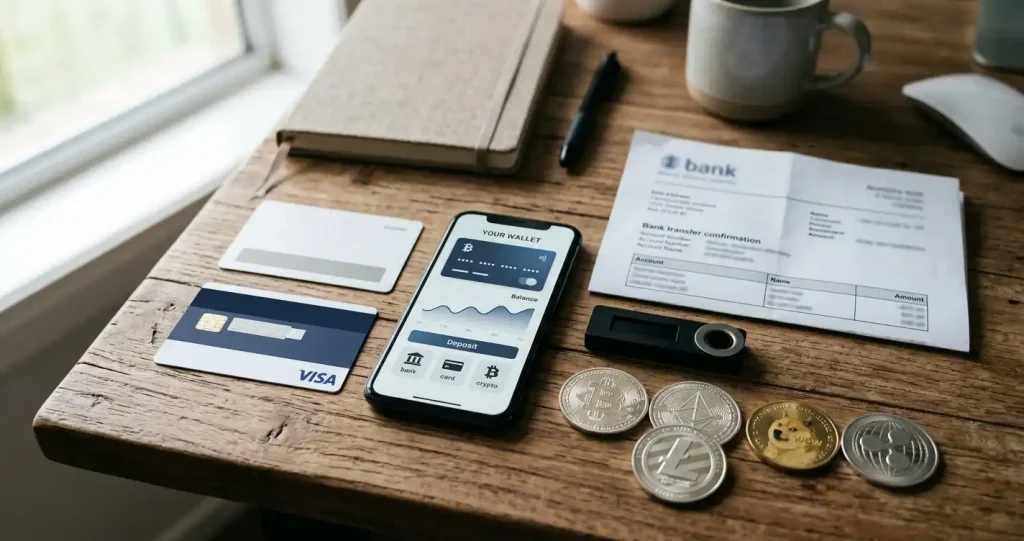
Stellar Spins uses a mixed deposit setup rather than a single payment channel. Visa and Mastercard sit alongside Neosurf, bank transfer or InPay, eZeeWallet and Funanga, while BTC, BCH, ETH, LTC, DOGE and XRP are listed as cryptocurrency deposit options. The general deposit minimum is $10. The useful way to read that cashier is route by route: the method chosen affects where fees can arise, how a transfer can be reversed, and what checks should be made before money leaves a bank, wallet or crypto address.
Table of Contents
Deposit routes across fiat and crypto
The clearest deposit options are the mainstream card and crypto rails. Visa and Mastercard are both listed, as is Neosurf. Stellar Spins also names bank transfer or InPay, plus eZeeWallet and Funanga, in its current banking material. On the crypto side, deposits are listed for BTC, BCH, ETH, LTC, DOGE and XRP. Together, those routes cover several different ways of moving value, and each one creates a different practical checkpoint before a transfer is made.
| Deposit route | Listed method | What to check before sending |
|---|---|---|
| Cards | Visa, Mastercard | Currency, issuer rules and any card-side charge shown before authorisation. |
| Voucher | Neosurf | Voucher balance, denomination and whether unused value remains after the transaction. |
| Bank route | Bank transfer / InPay | Beneficiary details, transfer reference and any bank-side handling fee. |
| Other wallet routes | eZeeWallet, Funanga | Funding source, wallet balance and any service-side transaction cost. |
| Cryptocurrency | BTC, BCH, ETH, LTC, DOGE, XRP | Asset, destination address, network context and the amount displayed before confirmation. |
Cards are familiar because the authorisation step usually shows the fiat amount before approval. A voucher changes the sequence: value is purchased or held separately, then applied through the casino cashier. A bank transfer relies more heavily on the correct beneficiary and reference details. Crypto is different again because sending the wrong asset or using an incompatible route can be difficult or impossible to reverse once the transaction is broadcast.
Stellar Spins supports EUR, CAD, AUD and NZD as account currencies. That account setting is separate from the deposit instrument itself. An AUD account can still be funded through a card or a cryptocurrency route, but the route determines where conversion or network costs can occur. Keeping those two layers separate helps when comparing what the cashier displays with what a bank, wallet or exchange ultimately records.
- For a card deposit, compare the amount on the casino payment screen with the amount the card issuer is about to authorise.
- For a bank route, copy the beneficiary and reference exactly rather than relying on a previous transfer template.
- For a crypto deposit, match the asset and destination details before confirming the transaction.
- For any method, keep the deposit receipt or transaction identifier until the balance has appeared correctly.
The broader Stellar Spins payment-method guide maps deposits and withdrawals together. The distinction matters because a method that can fund an account does not automatically prove that the same rail is available for cashout.
What the no-fee claim does and does not include
Stellar Spins says it does not charge a casino-side deposit fee. That statement describes the operator’s own charge, not every possible cost attached to moving money. A card issuer can apply a transaction or currency-conversion charge, a bank can price a transfer, a voucher can be sold with its own commercial terms, and a cryptocurrency transfer can require a network fee. Those costs sit outside the casino-side fee statement.
A useful fee check therefore has two layers. First, identify whether the casino adds a charge to the deposit amount. Second, check whether the payment provider or network adds something of its own. If the cashier shows a $100 deposit and no casino fee, that does not guarantee that a bank statement, wallet balance or crypto transfer will also change by exactly $100. The difference can come from the payment rail rather than the casino.
- Read the amount the casino says will reach the account.
- Check the payment provider’s final confirmation screen for its own charge or conversion.
- For crypto, check the network fee before broadcasting the transfer.
- Compare the resulting casino balance with the payment receipt after the transaction completes.
Cryptocurrency adds price movement to that calculation. A deposit can arrive with the intended number of coins while the fiat value of those coins changes between purchase, transfer and later use. Network transactions are also generally irreversible. That makes address checking and fee checking more important, not because the casino necessarily charges more, but because the payment rail behaves differently from a reversible card authorisation.
USDT needs separate treatment. The current Stellar Spins banking table includes USDT, while a Stellar Spins crypto article says stablecoins are not supported. Those statements do not support one permanent yes-or-no answer for USDT deposits. The practical checkpoint is the live cashier attached to the account and the exact asset offered there at the moment a deposit is prepared.
How the brand describes crypto deposit timing
Stellar Spins gives two timing descriptions for cryptocurrency deposits. Its banking table says crypto deposits can take up to 15 minutes, while a separate crypto article says more than 95% of crypto transactions process in under 10 minutes. Both are operator statements about expected processing, not guarantees that any individual transfer will arrive inside a fixed window.
Crypto deposit time is made up of more than one stage. The transfer first has to be broadcast to the relevant network. The network then includes and confirms the transaction, after which the receiving platform has to recognise it and credit the casino balance. Congestion, fee selection, wallet behaviour and the casino’s own crediting process can all affect the elapsed time. That is why a short published estimate should be read as context rather than as a stopwatch.
A transaction identifier is the most useful reference when a crypto deposit appears delayed. It shows whether the transfer exists on-chain and whether confirmations are progressing. If the transfer is visible on-chain with the required network confirmations but the casino balance has not changed, the problem is different from a transfer that never left the sending wallet. Keeping those states separate makes a support conversation more precise.
- Before sending: compare asset, destination address and amount.
- After sending: retain the transaction identifier from the wallet or exchange.
- During confirmation: watch the transaction itself rather than repeatedly creating a new deposit.
- After confirmation: compare the credited balance with the amount expected from the cashier flow.
The timing description does not turn crypto into an “instant” deposit method. Even a commonly fast route can be delayed by network conditions or internal crediting. For a payment decision, the important distinction is between an estimated processing window and a guaranteed availability time.
The $10 general deposit floor
The general Stellar Spins minimum deposit is $10. A minimum is a threshold for submitting a transaction; it is not a recommended gambling amount. The practical effect is simply that a deposit below that floor may not be accepted under the general rule. Individual rails can still display their own transaction conditions in the cashier, so the method-specific screen remains the final operational checkpoint for the amount being entered.
Minimums also matter when currency and crypto units are involved. A fiat amount can be entered directly in a familiar account currency such as AUD, while a crypto transfer may be expressed in units of the asset. The wallet or cashier then has to translate that asset amount into the value relevant to the account. Because cryptocurrency prices can move, the fiat equivalent visible at one moment can change even when the coin quantity stays the same.
A sensible deposit check is therefore mechanical rather than promotional: confirm the amount, route, fee context and destination before authorising. The $10 threshold tells you where the general floor begins; it does not say anything about how much is affordable to lose. Gambling expenditure should come from a fixed discretionary budget, separate from rent, bills, debt repayments and other essential spending.
For the other side of the cashier, see Stellar Spins withdrawal limits and cashout rules. Withdrawal thresholds are higher than the general deposit floor and include a separate bank-transfer minimum plus a weekly cap.
Questions about Stellar Spins deposits
Section element
What is the minimum deposit at Stellar Spins?
The general minimum deposit is $10. Individual payment routes can still have their own transaction conditions, so the cashier amount shown for the selected method is the practical figure to check before sending money.
Which cryptocurrencies can be deposited at Stellar Spins?
BTC, BCH, ETH, LTC, DOGE and XRP are listed for deposits. USDT should be treated separately because current Stellar Spins pages give different answers about stablecoin support.
Does Stellar Spins charge a deposit fee?
Stellar Spins says it does not add a casino-side deposit fee. Card issuers, banks, voucher providers, wallet services or crypto networks can still apply their own charges outside the casino.
Mixed funding routes make the pre-deposit check method-specific
Stellar Spins offers several ways to fund an account, but the practical differences sit outside the simple method names. Cards, vouchers, bank routes and crypto each move money differently; the $10 general minimum is only one part of that picture. The most useful habit is to treat every deposit as a short checklist: verify the route and amount, separate casino-side fees from provider or network costs, and preserve the transaction record until the balance is correct. Crypto deposits add two more variables—price movement and irreversible transfers—so asset and destination checks carry particular weight.